Archive for the ‘Barack Obama’ tag
Obama’s Speculative Photo Op
It was, as usual, a carefully choreographed photo op: at an event hosted by LinkedIn, Barrack Obama promoted his $447 Billion jobs package that shall but Americans back to work. The current jobless rate of 9.1 percent is an extremely worrying figure that will likely define the upcoming elections. It therefore made sense to hold this town hall type of discussion with LinkedIn – an online tool for professional networking. Sitting next to Jeff Weiner, the charismatic and handsome CEO of LinkedIn, Obama sought to bathe in the glory of LinkedIn’s success story. Other visual markers reiterate this association: the LinkedIn logo is clearly on display throughout the room, the curtains represent the colour of the company and in the background are mainly LinkedIn employees.
Here, Obama appears to follow a pattern after visiting similar events hosted by Facebook and Twitter. The next year is election year and the Obama administration is carefully aligning itself with the major players of Silicon Valley. It was, after all, the power of the social network that helped Obama into power in the first place. If the social network can help Obama find a job, the underlining message of the photo op is that the social network can also help those that are currently still looking. It is a message filled with optimism and this most Obamaesque of words: hope.
On closer inspection however the main visual association with LinkedIn might come to haunt the Obama administration. It is true that LinkedIn is one of the great recent success stories of the boom in social media. In May 2011 LinkedIn was floated on the New York Stock Exchange which resulted in a market capitalization of currently $7.5 Billion. At the same time however, in the last quarter LinkedIn posted a net income of only $4.5 Million. In other words, LinkedIn’s capitalization does not reflect it’s current income, but rather, it reflects the market’s belief in future income. One of the main indices used to calculate the worthiness of a company’s stock is price-to-earnings ratio (P/E ratio) which, for most ‘traditional’ companies, hovers below or above 14. LinkedIn’s P/E ratio, on the other hand, is currently rated at 1100 either indicating an extremely high expectation in future growth or that the stock is subject to a speculative bubble. Obama’s association with LinkedIn is either based on extreme expectations, or, far worse, it is based on extreme speculation.
But there is another far more important reason why I believe the LinkedIn photo op was a rather ill fated event. Although LinkedIn claims to help those currently looking for a job, with just over 1.000 staff LinkedIn doesn’t actually employ many people themselves. This dilemma is better represented by comparing other companies with a similar market cap: US Steel ($3.35 Billion) employs 42.000, AMD ($4.42 Billion) employs 11.100 and Abercrombie & Fitch ($5.70 Billion) employs 9.000 full-timers whereas it also employs 76.000 part-timers. Obama’s association with LinkedIn is thus purely based on the superficial belief that indeed, LinkedIn creates job opportunities for those who subscribe to it’s services – some of which at a significant monthly cost for the user (I am yet to come across someone who actually got a job through LinkedIn).
A week ago the American Census Bureau published a shocking figure: 46.2 million Americans now live in absolute poverty. By far the worst statistics in the industrialized world, that figure represents nearly on in six Americans. Are these the people that sign up to LinkedIn in the hope of finding a job? Is it those people that have the internet connection that would even allow them to access LinkedIn in the first place? Are these the people that have the IT and media degrees that would make them potentially desirable in Silicon Valley? While these questions remain unanswered, the LinkedIn photo op represents an extremely risky strategy which ultimately hinges on LinkedIn’s continued success in the future. Similar to those investing in a vastly overvalued company, the President’s advisors will hope that LinkedIn’s stock prize has not quite yet reached a precipice.
To subscribe to this blog by email, please click here.
A Photo Op Gone Awry
The political aides and PR consultants of British prime minister David Cameron are usually very astute in arranging photo opportunities. Who could forgot the amazing footage of Cameron playing Ping Pong alongside Barack Obama at a school for children from low-income families in London. Cameron welcomed Obama in May 2011 to reinforce the transatlantic ‘special relationship’. As a result, rather than playing against each other, Cameron doubles up with Obama as they play against two school kids. Cameron might have been slightly overzealous when he high fives Obama on the odd point they scored against the kids, but in essence it was precisely the type of photo op Cameron and Obama were set out to deliver.
These photo ops are highly stage managed and orchestrated events for the assembled media. The angle of the camera, the height of the camera, the distance of the camera to the main subject, the use of artificial or ambient light and the use of personal microphones or sound booms is carefully considered in support of an ideological agenda. So it was the case on the 14th of June 2011 when David Cameron, his deputy Nick Clegg and the Secretary of State for Health Andrew Lansley visited Guy’s hospital in London. The visit coincided with the governments announcement of a recently modified and highly controversial National Health Service reform bill. The emphasis in this reformed bill, it is argued, is on patient care. In other words, the patient is on the top of the agenda.

Nick Clegg and David Cameron at Guy’s hospital
As a result of this re-found emphasis on patient care, the photo op on that day, naturally, would involve a patient. Both Cameron and his deputy Clegg are filmed and photographed as they somewhat casually speak to a hospital patient in his bed. In line with hospital requirements to avoid the spreading of viruses, Cameron and Clegg have rolled up their sleeves and have taken off their ties. Their bright white shirts evokes the image of a doctor’s coat. Here, clearly, prime minister and his deputy briefly perform the role of doctor and head nurse deeply concerned for the well-being of their patient. The added benefit of choosing to speak to an elderly patient, as opposed to a younger person, is that the government projects an image of caring for pensioners – precisely the type of person who paid a life’s worth of taxes and who now deserves to be taken care of when ill.

Dr. David Nunn disrupting a photo op
Yet, precisely because the photo op is so carefully stage managed, it is also prone for accidents. To the utter surprise of everyone, a man claiming to be the most senior surgeon in charge storms into the room by shouting ‘sorry, sorry, sorry …’. By pointing at the camera crews’ long sleeves and ties, he continues: ‘Why is that we are all told to walk around like this and these people…?’ As the regulations clearly state, no long sleeves and ties are allowed in the vicinity of the patient. The man bursting into the room and shouting at TV crews is an absolute photo op and PR disaster. Cameron and Clegg’s near identical facial expression is one of disbelief and bewilderment. The patient meanwhile displays a rather nervous smile. Cameron seeks to diffuse the situation by telling the assembled members of the press: ‘Why don’t we erm, why don’t we, why don’t you disappear… I agree.. out… because we’ve all taken our ties off.’ The perturbed and bow tie wearing surgeon meanwhile (his name is Dr. David Nunn), angrily gesticulates at the TV crews and shouts ‘I’m not having it, now OUT.’ Watch the incident unfold on this Youtube clip:
Dr. David Nunn’s now infamous disruption of the photo op is noteworthy. He is, by totally defying the usual respect and professional distance associated with the photo op, disassembling the very ideological foundation of the event itself. In a matter of a few seconds, all over sudden its not Cameron and Clegg that are in charge, but David Nunn – as he points out the most ‘senior surgeon’ on the ward. Nunn effectively calls an end to the photo op by ordering the TV crews out of the ward. The bizareness of the situation is reinforced by the cameras beginning to shake as their operators head for the exit. If we compare the photo op to (political) theatre, Nunn’s intervention calls to mind the radicalism of the German playwright and director Bertholt Brecht. In his plays, Brecht invited to audience to take a critical view of the action on the stage. Brecht employed the use of techniques that remind the spectator that the play is a representation of reality and not reality itself. Similarly, David Nunn effectively highlighted the constructed nature of the photo op itself and as a result, it turns into a farce. In other words, the photo op loses its very purpose once its constructed nature is uncovered. David Nunn, apparently a brilliant hip replacement surgeon, reminds us in comical fashion how fragile the political stage can be.
To subscribe to this blog by email, please click here.
The President’s Haircut

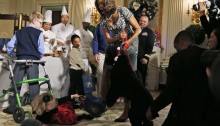
President Barack Obama bends over so the son of a White House staff member can pat his head during a family visit to the Oval Office May 8, 2009. The youngster wanted to see if the President’s haircut felt like his own. (Official White House Photo by Pete Souza)
As Barrack Obama is undergoing a ‘shellacking’ in the midterm elections this fall, I want to look at his legacy of photographic representation. There are hundreds of photographs, many of them taken by the official White House photographer Pete Souza, that have become symbolic for the optimism with which Obama was voted into power in 2008. Since then, the Obama administration has long fostered the power of photographic representation. The White House has even installed their very own Flickr account in which the best of Souza’s photographs are made available to the public free of any copyright restrictions. The moments captured are to a large extent so-called photo ops – those are carefully stage-managed moments provided to press photographers in order to support an ideological agenda. It was a similar type of photo op that took place in the White House on the 8th of May 2009: White House staff were invited to bring along their families to meet the president in person. The omnipresent Pete Souza was in the Oval Office, snapping away, while the family members took advantage of such a rare opportunity. And then, something unexpected was about to happen as a young boy asks Obama if he can touch his haircut to see if it feels like his own. Obama laughs, leans forward, bowing to a 90 degree angle, so that the young boy can touch his hair. For a press photographer, this is like gold dust falling into the lap. The official and often tedious photo op reveals a far more interresting and unexpected photo op within its own right. The photograph itself reveals that this moment has likely caught Pete Souza by surprise as well: unlike most of Souza’s work, this photograph is more clumsy, the composition slightly awkward as Obama’s face could only be captured at an angle, the shape of his body is not as accentuated as it could be, the family members expression has not been captured either. In other words, the compositional flaws in the photograph themselves signify the realism of this unexpected moment.
Children and presidents make for iconic photographs. In the Oval Office specifically, John F. Kennedy already ventured on this territory with a photograph of him working on the famous oak desk, while his son is hiding underneath. The photograph portrayed Kennedy as a family man, in touch with his children, and, by extension, in touch with the Amercian people. At the same time, Kennedy does not appear to be overly distracted by his son. This too is an important aspect in the photograph since Kennedy seems, despite his smile, unfazed about what is going around him. He is not distracted by his son, nor is he distracted by the photographer. The symbolism of this determination is particularely useful in light of the Cold War and the Cuban Missile Crisis. Kennedy had to potray himself as a man who would never be distracted, though at the same time, also a man with a conscious.
Pete Souza’s photograph of Sasha Obama sneaking up on Obama behind a couch in the Oval Office has similar, largely positive, connotations. As a respected lecturer on photojournalism, it is likely that Souza himself knew of the symbolic power of the JFK photograph when he took this shot. The photograph of the young boy touching Obama’s head similarly portrays the president as a family man, despite the child not being his own. The broad smile on Obama’s face also signifies his humourous side, that he also allows himself not be taken too seriously. Here is the president of the United States bending over for a small boy so that he can touch his head. Everyone in that room that day saw the funny side in this moment.
On closer reading however, there are fundamental reasons that separate the photograph of the young boy and Obama from all others. As Obama is bending over for the boy, the viewer reads this as a reversal of roles. The boy stands tall with a straight expression like an adult, while it is Obama that is overcome by a childlike chuckle. The adult’s typical patting on a child’s head is also reversed – here it is the child that is patting the adult’s head. It’s as if the boy praises Obama, similar to the Queen knighting a distinguished citizen. This reading is also underlined by the position of the subjects in the frame. While Obama stands near the centre of the room, the boy, the visitor after all, stands in front of the famous oak desk as if its his own. He is wearing a shirt and a tie, as if his jacket is hanging on the chair behind the deask. In the photograph, the boy becomes the president and Obama the visitor, chuckling like a child and slightly embarressed with his hands in his pockets. This is not to say that this photograph, potentially embarressing for the president, ruptures an ideological agenda disseminated in the photo op. Quite the opposite. The overriding signifcation here is that this boy, if he studies and works hard, can, like Obama, become president. It is the quintessential American Dream that this photograph seeks to capture. This signification is even further underlined with reference to Obama’s own background, that he too was once a young boy, and more importantly, a young black boy, with big dreams.
And this is maybe the most important aspect in the photograph that also radically separates it from any other Child+President+Oval Office=Photo op equation attempted in the past. The photograph is about race and ethnicity. Let me quote from the official caption: “The youngster wanted to see if the President’s haircut felt like his own.” The black and curly hair of the boy and the President alike are signifiers of their race. In other words, the young wants to feel, as if seeing is not sufficient, if the president is as black as he is himself. The boy was likely not that aware of the underlining racial interpretation his inquiry could reveal. However, and this is important, those that provided the official caption were most likely aware of the significance of the boys’ reference to to the President’s haircut. The caption dramatically affects the reading of the image: it means that boys like him, in spite of a discourse that seeks to separate races by the appearance of hair, can one day bow to the next generation of potential presidents.
To subscribe to this blog by email, please click here.


