
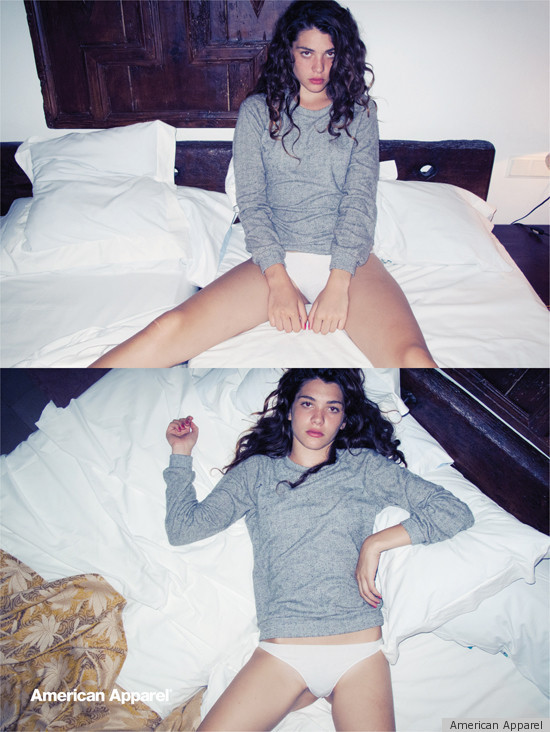
This American Apparel ad, alongside several other similarly suggestive ads from their website, has recently been banned by the Advertising Standards Authority ASA in the United Kingdom. In this blog post I am not arguing whether or not this ban is justified, but rather, I want to analyse the reasons for the ban itself. In a statement, the ASA explained their decision as following:
“We considered that in the particular context of images which featured nudity and sexually provocative poses, there was a voyeuristic and ‘amateurish’ quality to the images which served to heighten the impression that the ads were exploitative of women and inappropriately sexualised young women.”
Important here is the word ‘amateurish’ – purposefully put into quotation marks to underline the potential vagueness of the term. So what exactly makes the images in the American Apparel campaign ‘amateurish’? Rejecting the ASA complaint, an American Apparel spokesperson supplied a useful starting point for this question by arguing that the subjects in the photographs are ‘real, non-airbrushed, everyday people’. American Apparel’s casual response to the ASA complaint neatly disguises the fact that the subjects in the photographs are not merely ‘people’, but they are women, young women, carefully selected (and thus not ‘everyday’ by definition) to suit a brand identity. Despite this inherent contradiction, American Apparel’s statement that the women in the photographs are real and non-airbrushed directly corresponds with ASA’s assessment that the images are ‘amateurish’. In other words, the perceived realness of the female subjects is one of the determining factors in creating images that are deemed ‘amateurish’.
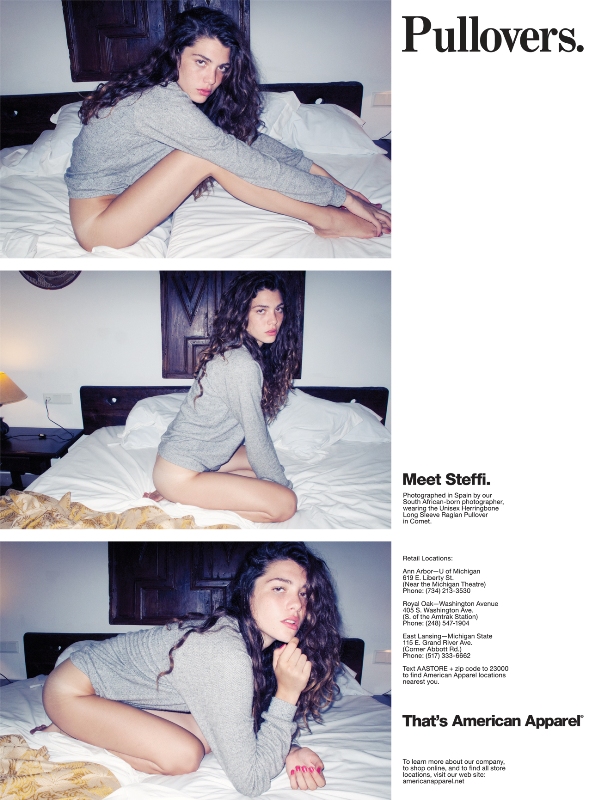
American Apparel quite openly plays with this notion of the amateur since the subject in the photographs is an amateur model as opposed to a professional model. The ads themselves seek to support this narrative by including text such as ‘Meet Steffi’. Notably, unlike the Campbells, Schiffers, or Evangelistas of the past, ‘Steffi’ has no last name, further signifying her status as amateur plucked from a crowd of ‘everyday people’. The bland and seemingly ill-considered location, the unmade bed (perhaps in a hotel room), even the cables from a bedside lamp all contribute to the perception that the images are amateurish. Lastly, the way the photographs were taken – namely with a direct flash light perhaps mounted on a point and shoot camera and seemingly accidental framing – further signify the amateurishness in the image. ASA’s assessment that the images appear exploitative and voyeuristic is provoked by the patriarchal vantage point of the photograph – the male photographer pointing down the camera and thus dominating over the female subject. Here, the downward gaze functions as a metaphor for sexual domination. Looking at all these variables in the photograph, I would argue that rather than the subject signifying the ‘amateurish’, it is the way that the photographs were taken that contribute to this perception the most. In other words, it is not primarily the subjects in the American Apparel ads that are amateurish, but the photographs.

Establishing this important distinction between amateurish subjects and amateurish photographs helps to understand why specifically these American Apparel ads were banned by the ASA. Take for example the recent shoe campaign by the British pop singer Cheryl Cole. Similar to the American Apparel ads, the position of Cole’s exposed legs, the hands in between her legs, and her gaze back to the camera are all sexually suggestive. Yet the fact that Cole’s campaign was not banned (and I am sure that there are many similar campaigns that also have not been banned) relates less to the gesture, position or the state of undress of the subject, than it relates to the setting, format and technique of the photograph. Unlike the American Apparel ads, the shoe campaign was photographed in a studio, under controlled lighting with professional grade equipment. For the lack of a better term, it’s a professional photograph.
As a consequence of this logic, it must be deduced that professional looking photographs – no matter how exploitative, voyeuristic or sexually suggestive they may be – are less likely banned. The assumed professionalism and perfection of commercial photography thus appears to legitimise the sexualisation of women (as well as men). The more perfect (and therefore less real) the photograph, the more sexual the context of the photograph can be.
Yet there is, I believe, another reason why Cheryl Cole’s ad is unlikely going to raise eyebrows with the ASA and the majority of the public. As the shoes make up a central part of the image, the photograph clearly reads as an ad for shoes (if not fashion as a whole). So in addition to professional-looking and therefore non-amateur photography, images with a clearly decipherable commercial agenda appear to be more legitimate. This clarity about the commercial intent of the brand is completely absent in the American Apparel ad: although the viewer knows it’s an ad for clothing, the photograph could easily be a snapshot in a private photo album or a men’s magazine. The ambiguity of what exactly the photograph seeks to promote thus filters into a number of other ambiguities apparent in the photographs: the ambiguous age of the young woman, the ambiguous reference to a sexual act as signified by the unmade bed and the ambiguous presence of a potentially exploitative and voyeuristic Other (e.g. the photographer himself). Paraphrasing the unlikely source Donald Rumsfeld, it’s these known unknowns that most likely triggered the banning of these ads.
For more on the representation of gender in the media, please read my posts The Perfume Ad Formula and The Aesthetics of Artificiality.
Become a supporter of this blog.


Yeah… and also, she’s naked from the waist down. So it looks as if she just had sex with whoever took the picture.
i was myself wondering when you were finally gonna make reference to that very fact. as usual, it’s what you don’t see that ‘offends’. i do not see knickers. i am excited! i must ban this immediately.
great post!
fascinating post.
I saw the word ‘amateurish’ and I thought of ‘amateur porn’. And i think one reason this is more risque than an obviously professional shoot, is that it has echoes of potentially non-consensual porn (and even sex).
Ever since ‘readers wives’ where men send in photos of their female partners in various states of undress to Playboy etc, ‘amateur porn’ has become more sophisticated, and more monitored.
There is a chance that sometimes people are filmed/photographed in a sexual situation without their consent.
Now it is obvious this model knew she was being photographed but the style of the photos does seem to be alluding to a more ‘murky’ world of online and child pornography.
Cheryl Cole is famous. we know she makes a living out of ‘selling her body’. This young women is practically anonymous and could represent vulnerable people.
I would not ban it. I’d ban those American Apparel ads of skinny white hipster boys topless. They’re awful!
The comments here say it all. No pants indeed. Why must Amateurish always = revelling in the grim? That’s never going to read as anything other than skeevy and screams ‘exploitative’. It is however, very anti-fashion and ‘hip’. Sad fact of the world today. So the fact that these ads were banned will only add to their appeal. It’s tragic.
thanks for the article! interesting topic to distinguish between amateurish looks and photographers!
how come everybody (including me) tends to believe that the girls and boys in the american apparel ads are amateurs, everyday-people? i think they put this myth into the world when they asked their customers to sent in photographs of themselfes wearing american apparel clothes. the spontanious point and shoot style of the pictures is still the same, but they would be stupid to wait for good amateur picutres, better to hire some pro with skills like terry richardson to be sure to get the right picutres. to keep the myth of the amateurish heritage of the image alife is good for them.
the model charlotte states to work for american apparel as a model for exemample in this article:
http://www.vice.com/read/girls-of-hollywood–0000174-v19n4
Very thought-provoking! They shouldn’t be banned in my opinion, just deplored.
If you look carefully at many of the AA ads you will see that the “amateurish” look is indeed meticulously constructed with carefully controlled professional equipment (and studio prowess). Many them are clearly shot with a ring flash – a “serious” professional one, not the “hipster photography” grade ones that are suited for macro work at best. I’m talking about the big, awkward, expensive and powerful fashion lights that you really need a power pack and two assistants to operate properly. The images above may have been shot this way…it is hard to tell. I can’t find a version with high enough resolution that I can see the tell-tale doughnut-shaped catchlight in the eyes. But the shadowlessness of the area around and behind her, and the long, even highlights along her exposed limbs are the work of either a ringlight or another high-powered professional modifier. The image _implies_ the use of direct, on-camera flash but it seems to lack some of the garish side-effects of that kind of lighting. It uses the visual language of amateur photography, but in the same way that a professional film director will use 8mm footage or clips that appear to have been shot on a cheap camcorder: rather than using genuine amateur footage they prepare professional renderings of amateur visual tropes.
The American Apparel art directors are also very conscious of other signifiers of “amateur” vs “professional”. In the case of the image above, they make use of the difference in colour temperature between the lamp in the background and the daylight-balanced key light. This is a hallmark of the amateur snapshot: yellow-orange coloured light from lamps that are in the frame. In an age when the colour temperature of all light sources can be easily managed (whether on set or in post production) the choice to leave the colour contrast in these images is highly intentional and meant to evoke an amateur feel.
I think it is important to acknowledge the way in which AA manipulates and patronizes their audience through these techniques. They want the reader to relate to the photograph, to feel that the badly lit, colour imbalanced, randomly framed images that they produce from their P&S or iphone are being validated through full-page ads in Now Magazine or the Village Voice. AA wants the reader to internalize the ad, and they are using every trick they can muster to capitalize on the explosion of amateur photography over the last decade.
This is a great article – many thanks for taking the time to post it!