

The latest political scandal that is currently sweeping across the United States is the child separation policy – a cruel and inhumane policy that means that children of asylum seekers attempting to cross the Mexico/US border get separated from their parents. A steady drip of images published in recent days is not only bringing this issue to a wider attention, one could argue that public awareness to this policy is actually dependent on its visual representation through photography. In other words, public awareness to the issue and the photographic depiction of the issue are perhaps necessarily going hand in hand.
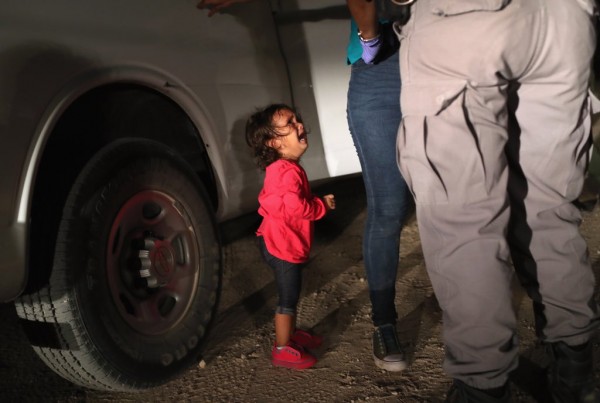
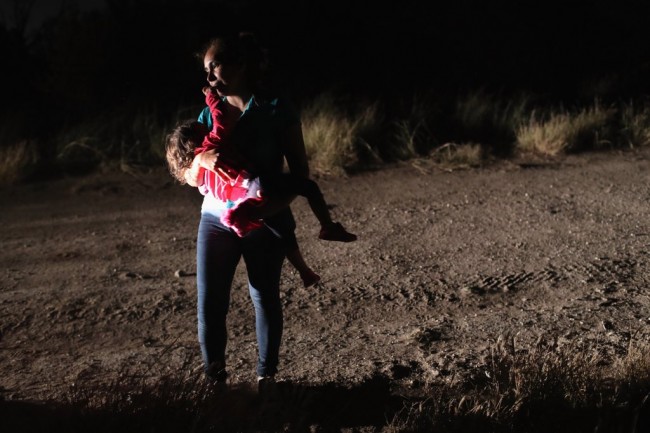
A watershed moment occurred when the Daily News decided to publish a particularly heart-breaking photograph for their 16th of June issue. The photographer John Moore captioned this image on Twitter as following: “A Honduran asylum seeker, 2, and her mother are taken into custody near the US-Mexico border. The Trump administration’s “zero tolerance” policy for undocumented immigrants calls for the separation of parents and children.” Other news outlets in the United States followed suit and soon the image of the little girl crying whilst her mother was searched by a border guard was shared widely on social media. The power of the image rests on a number very important visual clues that are important to emphasise. The first is the vantage point of the camera: the image is taken from a low vantage point thus allowing the viewer to empathise with the child who is now at eye level. The viewer is not looking down at the child, but is looking at it from a similar height. The consequence is that the viewer feels compelled to see the world from the child’s viewpoint – a very powerful visual analogy in this context.
Once this empathetic viewpoint is taken up, the other aspect that really stands out in this image is that the two figures to the right of the image – presumably the mother and a border guard searching her – are not fully visible. A close reading of the image might suggest that the crying child is looking up, not at her mother but by the border guard searching her mother. The two figures however remain anonymous as only their lower bodies are visible in the image. By framing their bodies in such way, the photographer end up protecting the identity of the two adults in the image, whilst it explicitly does not protect the identity of the only child in the image. The framing brings up an immediate ethical concern that also must be raised: whilst the identity of the adults in the image has been protected, why hasn’t the child been granted the same sort of rights? In the absence of being able to grant permission to photograph, can the rights of the child be overridden by the newsworthiness of the story captured by the photograph? If a child cannot be made responsible for the actions of his or her parents, why does the photograph focus on the child who lacks agency, and not on the parent who makes decisions on the child’s behalf?
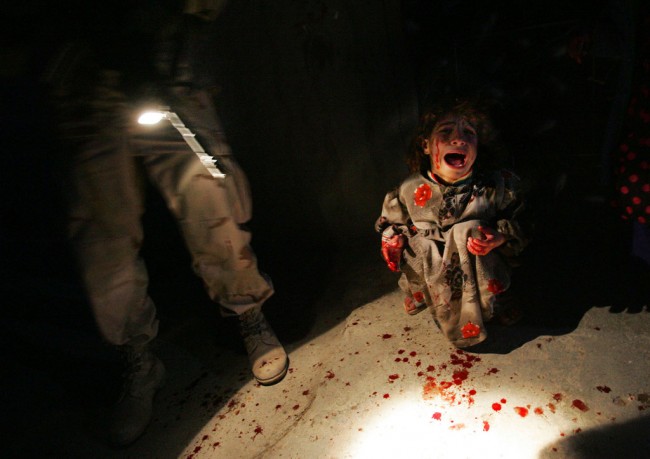
There are two images that I am immediately reminded of: the first one is that of little Samar Hassan who was photographed by the late photojournalist Chris Hondros in 2005. Hondros’ image of Samar screaming is one of the most gut-wrenching images that emerged from the war in Iraq. The fact that images from the US/Mexican border are visually comparable to that of the Iraq war should give the powers to be some pause for thought. The other image that I am reminded of, and that I prefer not to punish here, is that of little Alan Kurdi, the Syrian boy who drowned off the coast of Turkey. Whilst the images are visually quite different, the children depicted in these images have a few aspects in common: far away from home, lost and vulnerable, at an age where they are not able to make decisions for themselves. One of the most heartbreaking aspects when I look at these photographs of children is that, in spite of their struggles, they are children’s clothes much like the clothes my own daughters would wear. This banal yet also rather important details provides an extra layer of empathy – in a different world these could by my children.
Much like the photographic depiction of Alan Kurdi’s drowning – a decision that was made quite deliberately in the UK by The Guardian Newspaper with other news outlets in Europe following suit – the front cover publication photograph of the little Honduran girl crying at the US/Mexico border feels like the dam has finally broken. These type of images cannot be hidden any more. They cannot fall through the cracks on the desks of photo editors. No. This type of image now must be shown.
Follow me on Instagram at @MarcoBohr


Hi Marco,
Thanks for this article. These are powerful images indeed.
It is interesting, I was just watching the Handmaids Tale, Season 2, Episode 10, last night on SBS in Australia.
There was a powerful scene where a child is ripped from her mother’s arms. It was such poignant timing with what has been going on at the US border, and the scene echoed these images you have talked about (only the parent was Anglo American, which may make it easier for white Americans to relate). This is a dystopian series, but it seems some of it is not very far from what is actually going on.
Best wishes,
Louise