

After a long period of radio silence (I have been busy getting my first book published), I am compelled to write a blog post about THAT photograph from the G7 meeting that is currently making the rounds on social media.
The German photojournalist Jesco Denzel undoubtedly captured a stunning moment when Chancellor Angela Merkel was leaning forward, her palms firmly pressing down on a table, as she was seemingly trying to reason with President Donald Trump at the G7 meeting. The body language in this image is very telling indeed and it requires a little bit of further dissection. Merkel’s hands on the table signify a sense of tension and firmness that is underscored by at least three other hands, those of Macron and that of a senior diplomat, resting on the table. Trump’s hands meanwhile are hidden as he is crossing his arms – a gesture that is mirrored by Prime Minister Shinzo Abe standing nearby.
The power of the image partially rests on the downward axis that is created between Merkel’s and Trump’s eyes meeting each other. The image appears to allude to a type of showdown where those on the left of the image, standing in the brighter part of the room, literally speak down to Trump – the only one actually siting. Trump is clearly standing out by the fact that he is NOT standing. The tension of this scene is underlined by two rather important figures in the centre of the image: a senior Japanese diplomat who appears to be biting his lips and the National Security Advisor of the United States, John Bolton, who is looking at Macron and Merkel with incredulity: “When has the head of state of a European nation ever spoken to the President of the United States like that?”, he might be asking himself.
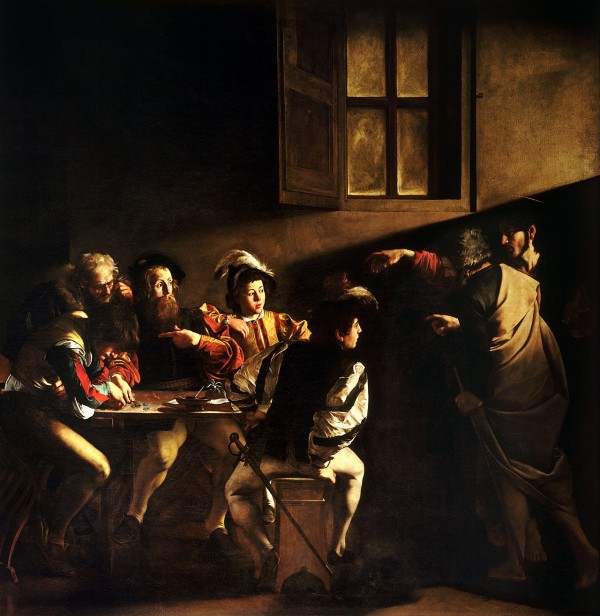
The Calling of Saint Matthew (1599–1600), by Caravaggio
On Twitter this image has been making the rounds with various people pointing out that it bears similarities with a Renaissance painting. Palle Hoffstein has pointed out however that rather than bearing a resemblance to the Renaissance style, where subjects “are evenly spaced across the canvas, equidistant to the viewer as if on a stage” such as in the work of Botticelli, the G7 photograph is much more reminiscent of a Baroque painting where the “subjects are positioned naturally in the room, some have their backs to viewer, and postures reflect energy between the subjects” like in the work of Caravaggio. One of the intriguing aspects of the photograph is that although we have never seen it before, the visual style includes many aspects that appear awfully familiar – including Trump’s slight grin on his face.
For some, this image will tell a story that is far greater than the brief moment it captures between world leaders on the world stage: it tells the story of a geopolitical axis that is increasingly fragmented and out of balance. The post-war II status quo between western democracies seems, all over sudden, not so certain any more. I was born and raised in Germany – surrounded by literally dozens of American military bases and instalments – where THIS image of a German politician appearing to stand up towards an American President would have been virtually unthinkable even as little as a couple of years ago. And yet, here we have it: a German politician, a woman, flanked by her European allies, standing up … firmly. If geopolitical relations can be measured in photographs, this image arguably signals a new world order: not a unified G7 as has been the case for decades but a G6+1 as Macron already predicted via Twitter before the meeting took place. Perhaps this photographs is merely a visual manifestation what many people inside the high ranking political circles already knew.
This brings me to the last point of this image which is an aspect that is usually not recognised or downplayed in this type of discourse. The power of the image is not only the visual story that it appears to tell, but it is the fact that it was released by the German government in the first place. As I extensively analyse in my chapter in the book ‘The Evolution of the Image’, increasingly photographs on social media are being used a type of political weapon. In my chapter I analyse the Trump administration’s attempt to counter the narrative of his inauguration crowd which appeared smaller compared that of Obama’s inauguration. Crucially, this discourse emerged not because of specific attendance numbers or any other compelling statistics, but because of a comparison between two photographs. These photographs were taken from a very particular angle with a very particular and therefore communicated a very particular “truth”. On the world’s political stage too, the perceived “truthfulness” of photographs is being used a visual propaganda tool. This was, therefore, a very calculated move by the German government to release this exact image and not any of the other ones from that moment – ones that appear far less confrontational.
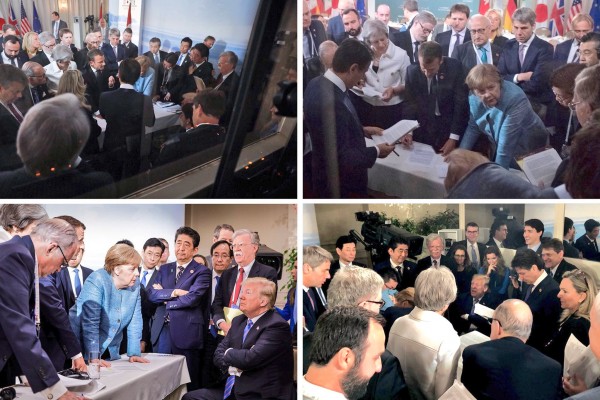
Using photographs for political purposes is not a new phenomenon. Ever since the birth pf photography, political figures have understood the power of the photographic medium. What is new however in today’s context is the speed at which these narratives are being spun on social media. Trump’s plane has barely landed in Singapore when the visual perception of him being told off by Merkel et al was already being cemented in the minds of millions of social media users. Whether he was actually being told off, or whether he was telling other world leaders off is nearly irrelevant. The only thing that matters during visual propaganda warfare is how quickly an image can be reach its intended audience and what perception this image creates.
____
I would like to take this opportunity to invite anyone who is interested in that type of debate to the book launch of ‘The Evolution of the Image’ on the 13th of June 6pm at the London College of Fashion. Please follow this link for a free ticket: https://www.eventbrite.co.uk/e/the-evolution-of-the-image-political-action-and-the-digital-self-tickets-46221813689


Great to have you back, Marco, and I’m looking forward very much to reading your book
Thank you James for the kind note. If you order the book directly through Routledge you can get 20% off with this discount code FLR40.
As an woman from the U.S. who loathes Trump, I was delighted to see a powerful woman stand up to him. He has declared a war on women, immigrants, the environment, the U.S constitution, and so much more. I am so desperate for justice that any sign of his defeat is welcome, even when it comes from the leaders of another country.
I would like to see the other images of this meeting from the camera of the German official photographer who I think is a German government employee and not a press photographer From my experience of covering US presidents (53 years) I know there is a practice of “editing with your eye”. The official photographer is deciding which instant to preserve for history. He o she might deny this. Dennis Brack